
If you’ve ever watched a R3,000 patio chair cartwheel off your stoep in a southeaster — or seen a sun lounger fade from charcoal to chalk in one summer — you already know the rules are different here.
Cape Town doesn’t go easy on outdoor furniture. The wind off Table Bay, the UV that bleaches anything left out, the salt air drifting in from Bloubergstrand to Muizenberg — all three conspire against poorly-made patio furniture. The good news: there’s a small group of materials and designs that genuinely hold up. After fifteen years of supplying restaurants, guesthouses and homes from Camps Bay to Constantia, we’ve seen what survives and what doesn’t. Here’s what to buy.
Why Cape Town’s weather destroys most patio furniture
Three forces do the damage, usually at the same time:
Wind. The southeaster (the “Cape Doctor”) routinely gusts 60–80 km/h in summer, and the northwester brings winter storms. Lightweight aluminium furniture flips. Cushions vanish. Anything top-heavy or with a wide back catches the wind like a sail. The fix isn’t always heavier furniture — it’s furniture with a low centre of gravity, a stable base, and a shape that doesn’t catch air.
Sun. Cape Town averages around 3,100 hours of sunshine a year — more than Sydney or Barcelona. UV breaks down cheap plastics, fades fabric, and dries out untreated wood. Furniture rated for “outdoor use” in Europe often has nowhere near the UV stabilisers needed for a Western Cape summer.
Salt air. Anything within 5–10 km of the coast — which is most of the Cape Peninsula — picks up airborne salt. Salt eats untreated metal, corrodes screws, pits aluminium, and shortens the life of fabric. Even the powder-coated steel that survives in Joburg can be a poor choice in Hout Bay.
The materials that actually work
Forget what looks good on Pinterest for a second. For Cape Town, three materials consistently outlast the rest.
UV-stabilised polypropylene (PP) is the workhorse of modern outdoor furniture. The good European versions — Italian-made Siesta Exclusive, in particular — use fibreglass-reinforced PP with high concentrations of UV inhibitors. They don’t fade, don’t corrode, don’t need oiling, and you can hose them down. They also tend to be light enough to move but well-balanced enough to stay put.
Marine-grade aluminium with a powder-coat finish handles salt better than plain steel. The catch: it must be aluminium and properly coated. Cheap aluminium with a thin paint layer will pit within two seasons in Sea Point.
Teak and other oily hardwoods survive Cape Town if you accept the silvering and don’t fight it. Teak’s natural oils repel water and salt. Pine, oak and most South African indigenous woods don’t have the same chemistry — they need annual sealing if they’re going to last.
What to avoid: untreated mild steel, soft plastics that aren’t UV-rated, MDF or chipboard “outdoor” furniture, and rattan that isn’t synthetic resin.
Sun loungers that hold up around the pool
A pool lounger lives the hardest life of any piece of outdoor furniture you’ll buy. It’s permanently in the sun, splashed with chlorinated water, sometimes left out overnight in a storm, and stacked when guests arrive. It needs to take all of that without complaint.
The Slim Pool Lounger is the one we put next to our own demo pool. It’s made from UV-stabilised resin with a slim, contemporary profile, it’s stackable for storage (a real consideration when the wind picks up), and it comes in white and a couple of muted colours that don’t fade. The shape sits low to the ground, which matters in a Cape Town wind — a chunkier traditional lounger acts like a sail.
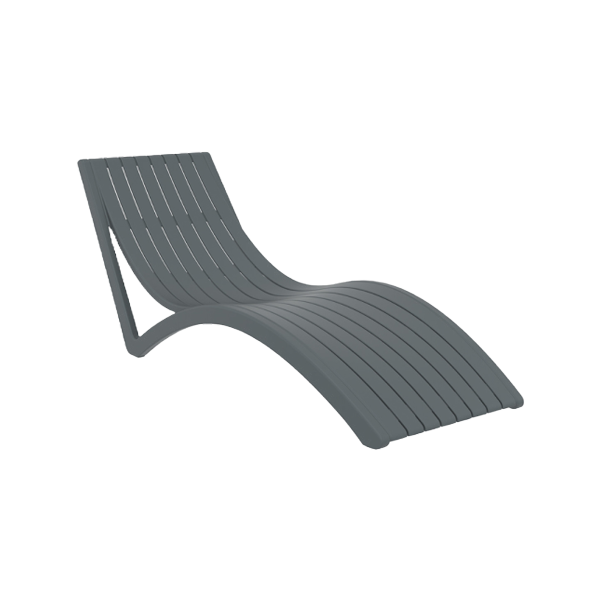
Slim Pool Lounger — stackable, UV-resistant, low-profile to handle the southeaster
If you’re furnishing a guesthouse or boutique hotel pool deck, buy in multiples and stack them against a wall when there’s a storm warning. They’re light enough that one person can move six.
Bar stools for outdoor entertaining areas
Outdoor bars and built-in braai counters need stools that handle weather and weight. Bar height is the awkward one — taller stools have a higher centre of gravity and catch more wind, so material and base design matter more here than on a short dining chair.
The Tom Bar Stool (75cm) is one of our most-specified outdoor stools, and for good reason. It’s a single-mould Italian polypropylene piece — no joints to fail, no metal to corrode — with a wide, weighted base that resists tipping in wind. It stacks (handy for restaurant patios that close up), and the colour range is muted enough to suit most Cape architectural styles.

Tom Bar Stool 75 — Italian PP, stackable, no metal to corrode
For something with a bit more personality, the Isabella Barstool brings a softer, more residential look while still being built for outdoor use. It’s a popular pick for poolside bars and home entertainment areas where you want the stool to disappear into the architecture rather than dominate it.

Isabella Barstool — residential-feel outdoor bar stool
How to set up wind-resistant outdoor furniture
The chair is half the battle. The setup is the other half. A few practical things we tell every restaurant and homeowner:
Choose furniture with a low profile and a wide, weighted base. Tall, narrow chairs catch the wind. Anything with a solid back panel (like a wingback) will be lifted by gusts.
Cluster, don’t space. Furniture grouped together breaks the wind for itself. A single chair on a wide stoep is a kite. Six chairs around a table, with the table acting as an anchor, will sit through a gale.
Use cushion clips or covered storage. The cushions usually fail before the frames do. Keep them in a weatherproof box, or use the snap-on clips that hold them to the seat.
Stack and store when storms are forecast. Stackable chairs and loungers exist for a reason. Five minutes of moving furniture against a wall before a known southeaster saves you replacing it.
Rinse occasionally. A quick hose-down once a month, especially if you’re near the coast, keeps salt off the surfaces and dramatically extends the life of any metal components.
What about under cover vs fully exposed?
If your patio is fully roofed and walled on the windward side, you have many more options — a wider range of materials, fabrics and finishes. If it’s open to the sky and the wind, stick to the materials above and accept that anything else is a short-term decision.
The middle ground — a roofed patio open on the sides — is where most homes sit. Here, UV is less of an issue but wind and salt still are. Polypropylene and powder-coated aluminium remain the safest bets.
Ready to set up a patio that survives Cape Town?
We carry a wide range of outdoor and pool furniture built for South African conditions, with stock available in both Cape Town (Woodstock) and Johannesburg (Midrand). Come and see the chairs in person, or browse the full outdoor range online.
Visit us in person:
Cape Town: 176 Sir Lowry Road, Woodstock
Johannesburg: Unit 2, 64 Lechwe Street, Midrand
[email protected]