
Children are the toughest quality-control department any chair will ever face.
If you’ve ever replaced the same wobbly seat twice in one school term, you already know the problem. Buying kids chairs in South Africa usually comes down to a choice between something cheap that lasts a year and something built properly that lasts through several children. This guide covers what actually matters in junior furniture: sizing, materials, safety, and how to kit out a classroom or playroom without blowing the budget.
What separates good kids chairs from cheap ones
A children’s chair takes punishment an adult chair never sees. It gets tipped onto its back legs, dragged across tiles, stood on, climbed over and stacked in a corner at the end of every day. The failure points are predictable: the leg-to-seat joint loosens, thin plastic goes brittle and cracks at the stress points, and painted metal starts rusting where the coating has chipped.
The chairs that survive tend to share three things. They’re moulded in one piece or joined with proper mechanical fixings rather than glue and staples. They’re made of a material that flexes slightly under load instead of snapping. And they’re light enough that a six-year-old can move one without dropping it on their toes. Weight matters more than most parents expect, because a chair a child can’t lift is a chair an adult ends up rearranging forty times a day.
Getting the size right: seat heights for growing children
Most kids sit badly because the furniture’s wrong, not because they’re fidgeting. If a child’s feet dangle, they’ll hook their legs around the chair legs and slide forward. If the seat’s too high relative to the table, they’ll hunch. Neither is a discipline problem.
The rule of thumb is simple: seat height should be roughly a quarter of the child’s standing height, with feet flat on the floor and knees bent at about a right angle. The table surface then sits about 27-30cm above the seat. As a rough guide by age:
- Ages 3-4: seat height around 21-26cm
- Ages 4-6: seat height around 26-31cm
- Ages 6-8: seat height around 31-35cm
- Ages 8-11: seat height around 35-38cm
- Ages 11-14: seat height around 38-43cm
For a home, you don’t need five sizes. Most families get better value buying one small set for the toddler years and then moving straight to a compact adult chair around age eight or nine. A lighter adult dining chair like the Minx PP Chair works well for that middle stage, because it’s low enough for an older child to use comfortably at the family table and still looks right when adults sit in it.
Why polypropylene dominates junior furniture SA schools buy
Walk into almost any well-run South African classroom and you’ll find polypropylene seating. There’s a good reason for that. PP flexes rather than shatters, so a chair that gets knocked over survives the landing. It doesn’t splinter like cheap timber, doesn’t rust like uncoated steel, and it takes colour right through the material instead of on the surface, so scratches don’t show up as pale scars.
It also cleans up. A wax crayon, a spilled juice box and a smear of playdough all come off a PP shell with warm soapy water and a cloth. Fabric seats don’t offer that, which is why upholstered kids chairs are usually a mistake anywhere outside a quiet reading corner.
The Candy Chair is our pick for the junior range. It’s a moulded polypropylene shell in bright colours, light enough for a child to carry, stackable for storage and completely at home either in a playroom or outside on the patio. The smooth shell has no exposed bolt heads or sharp edges, and because there’s no fabric or foam, there’s nothing to absorb spills or hold dust.
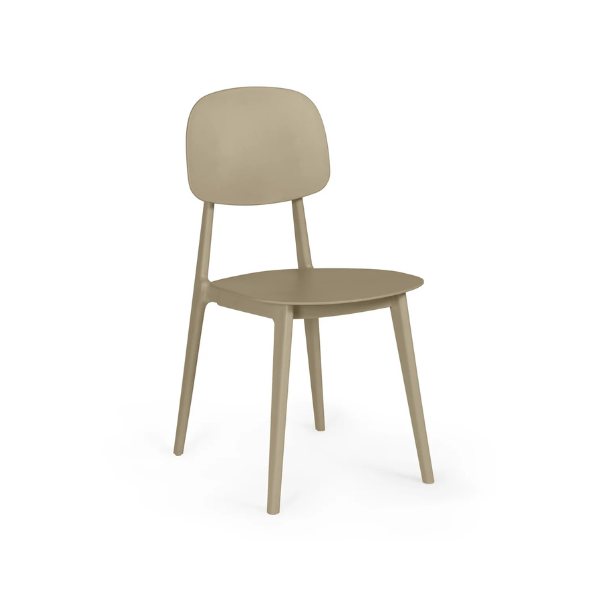
Candy Chair: one-piece moulded polypropylene, stackable, wipe-clean
For older kids and teenagers moving into shared study or dining space, the Maya Chair is the natural step up. Same wipe-clean, stackable, UV-stable logic, but sized and styled for adults, so it carries on working long after the homework years.
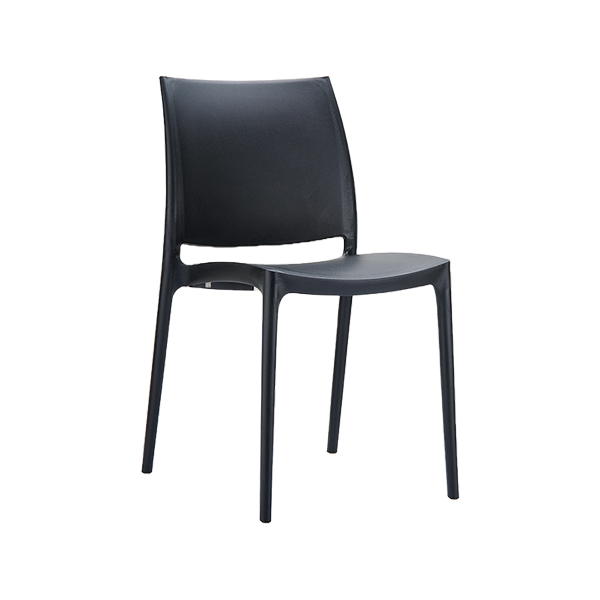
Maya Chair: stackable polypropylene, suited to indoor or outdoor use
Safety checks worth making before you buy
Most children’s furniture on the SA market is fine. A few things aren’t, and they’re easy to spot if you know where to look. Run through these before you commit:
- Check for finger traps. Any gap between moving or overlapping parts should either be under 6mm or over 25mm. The sizes in between are where small fingers get pinched.
- Push the chair sideways. A well-designed junior chair should resist tipping when a child leans out to one side. Narrow-based chairs with a tall back are the ones that go over.
- Run your hand along every edge. Moulded seats should have rounded edges everywhere, especially along the front of the seat where the backs of the legs rest.
- Look underneath. Exposed screw threads, sharp bracket corners and unplugged tube ends are all avoidable, and their presence tells you something about the rest of the build.
- Test the stack. If chairs stack, they should sit squarely and lock into position rather than perch. A leaning stack of eight is a hazard in a classroom.
Furnishing a classroom or playroom on a school budget
Schools and aftercare centres buy differently from families. Volume matters, storage matters more, and the real cost isn’t the purchase price but the replacement cycle. A chair at R400 that lasts eight years is cheaper than one at R180 replaced every second year, and it costs far less administrative effort along the way.
Stackability is usually the deciding factor. A classroom that doubles as a hall on Fridays needs chairs that go from floor to store in ten minutes. Round tables work well for group work at primary level, and something like the Kurv 60 Round Bistro Table gives you a compact four-seat cluster that’s easy to reconfigure. For a homework nook or a small study corner, pair a Safron Desk with a low stool or a properly sized chair rather than an oversized office chair the child will perch on the edge of.
One practical tip for schools: buy a handful of spares up front in the same colour and batch. Ranges change, and matching a discontinued chair three years later is a job nobody enjoys.
Keeping kids furniture looking decent
Maintenance on moulded furniture is genuinely minimal, which is most of its appeal. Warm water and mild dishwashing liquid handles almost everything. For stubborn marks, a soft brush and a paste of bicarbonate of soda will lift crayon and ballpoint without scratching the shell. Avoid abrasive scouring pads and solvent cleaners: they’ll dull the finish permanently.
If chairs live outside, bring them under cover during the worst of a Highveld hail season, and rinse off salt if you’re anywhere near the coast. Quality PP is UV-stabilised and will hold its colour for years in SA sun, but cheap unstabilised plastic chalks and goes brittle inside two summers, which is worth remembering when a bargain looks too good.
Ready to kit out the kids’ space?
Our junior range covers everything from toddler seating to chairs that grow with the family, all built to handle the kind of daily use a classroom or a busy home puts them through.
If you’re buying in volume for a school, aftercare centre or nursery, get in touch for trade pricing. You can also see the full polypropylene chair range if you’re comparing materials.
Visit us in person:
Cape Town: 176 Sir Lowry Road, Woodstock
Johannesburg: Unit 2, 64 Lechwe Street, Midrand
[email protected]