
Customers don’t just remember what they ate. They remember how they felt sitting in your restaurant. The chair, the table, the spacing, the noise level: it all adds up to whether they come back.
Restaurant interior design is often treated as a style exercise when it’s really a commercial one. The right dining room layout and furniture affects how long customers stay, how much they spend, how efficiently your staff moves, and whether the space survives two years of heavy use. This guide covers what SA restaurant owners need to get right: practically, not just aesthetically.
Start With the Cover Count, Not the Look
Before choosing a single chair, know your numbers. How many covers do you need to be profitable? What’s the minimum comfortable spacing per diner? In South Africa, the standard for full-service restaurants is 1.5–1.8 square metres per cover. Tighter than that and service becomes difficult; the noise level rises and the experience suffers. Looser than 2 square metres per cover and you’re leaving revenue on the floor.
Work backwards from your floor plan: total seating area divided by your target cover count gives you the space per cover. If it’s under 1.4 square metres, reconsider your layout before ordering furniture.
Chair Selection: The Decision That Affects Every Service
The chair is the most used piece of furniture in your restaurant, and the most scrutinised by customers. It needs to be comfortable for a 90-minute meal, durable enough for five years of daily commercial use, stackable for cleaning and storage, and coherent with your aesthetic. That’s a lot to ask of one piece of furniture.
The Maya Chair meets all of it for high-volume restaurants. UV-stabilised polypropylene, stackable, available in multiple colours, and comfortable for extended sitting. It’s the chair used in some of SA’s busiest hospitality venues for exactly these reasons. It handles the volume without showing it.
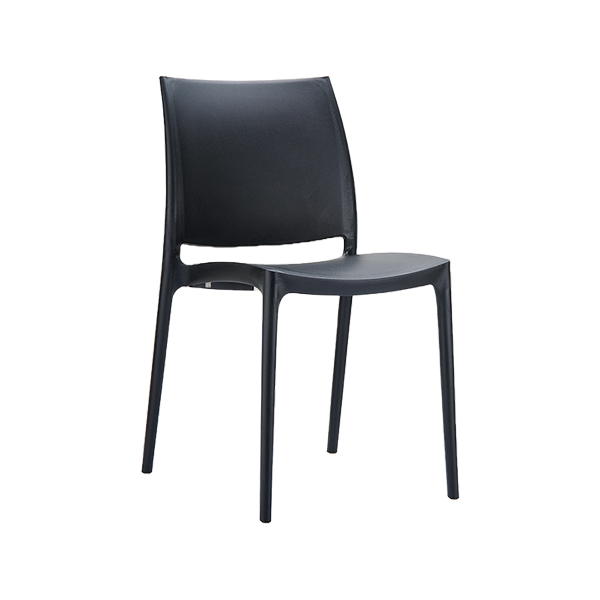
Maya Chair: commercial grade, stackable, available in multiple colours
For upscale or destination dining where the chair itself is part of the experience, the Carmen Armchair lifts the whole room. The armchair format encourages customers to linger, which works for restaurants with a high average spend and table turns that aren’t under pressure. For fast casual or high-turnover venues, armchairs slow things down; for fine dining, that’s the point.
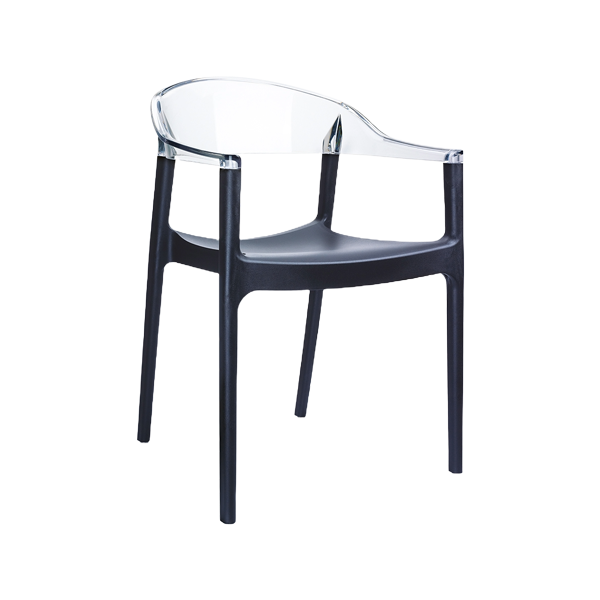
Carmen Armchair: designed for destination dining and longer dwell times
Tables: The Dimension Most Owners Get Wrong
Table width is the most commonly underspecified dimension in SA restaurants. A 60cm-wide table feels fine when it’s empty. With two place settings, a bottle of wine, condiments, and a bread basket, it becomes a logistics problem. 70–80cm width is the practical minimum for a two-cover table. Four-cover tables should be at least 80x80cm square or 80cm diameter round.
The Mika 120×80 Dining Table is a well-proportioned commercial table that works for four-cover settings, wide enough for a proper place setting on both sides with room for shared dishes in the centre. The profile is clean and contemporary, pairing well with both the Maya Chair and Carmen Armchair.

Mika 120×80 Dining Table: correct proportions for four-cover service
Layout: Zones, Flow, and the Mistake Most Restaurants Make
The most common layout mistake in SA restaurants is uniform spacing: every table the same distance from every other table, filling the room as evenly as possible. This kills atmosphere and makes every seat feel equally exposed.
Better approach: create zones. A banquette or booth area along one wall gives privacy-seekers their preferred seating. A more open central zone suits groups and social dining. Tables near the window fill first and command the most interest. The perceived best seats in the room should be visible from the entrance. If customers can see a desirable table when they walk in, they want to sit there.
Traffic flow matters too. Your staff need to move between tables and to the kitchen without threading through seated diners. A minimum 90cm aisle between tables is the working standard for service efficiency.
Acoustics: The Problem SA Restaurants Consistently Underestimate
Hard surfaces (tiled floors, concrete walls, glass) create echo and raise the ambient noise level until conversations become effortful. In a busy SA restaurant on a Friday night, this is a real quality issue. Upholstered chairs absorb some sound. So do soft furnishings, tablecloths, and acoustic ceiling panels. If your dining room feels loud when it’s full, the furniture and finish choices are contributing to it.
Ready to Fit Out Your Restaurant?
Visit us in person:
Cape Town: 176 Sir Lowry Road, Woodstock
Johannesburg: Unit 2, 64 Lechwe Street, Midrand
[email protected]